
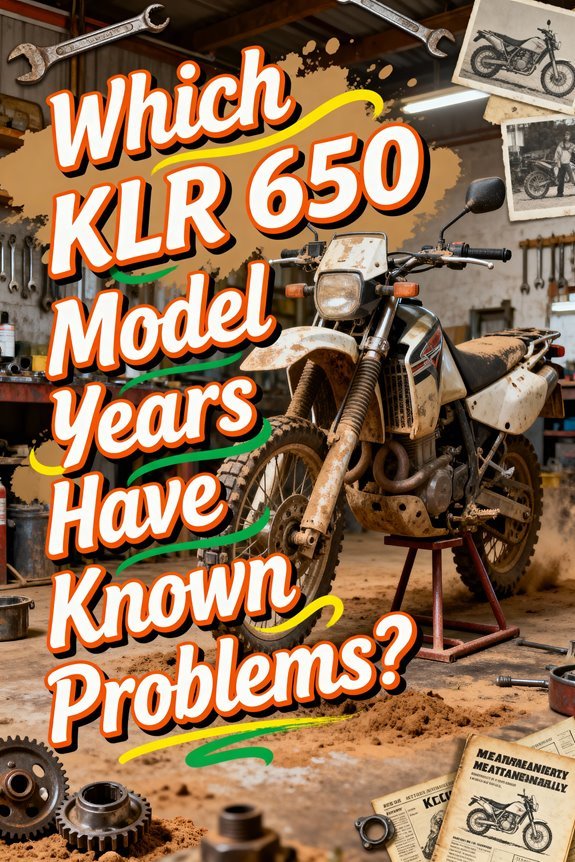
You’ll want to avoid 2008-2009 KLR 650s without verified fixes, as they’re plagued by severe oil consumption (one quart every 500-750 miles) from flawed piston ring design and a wiring harness recall affecting 16,167 units that caused fires. Pre-2008 models face doohickey failures between 5,000-15,000 miles risking catastrophic engine damage, while Gen2 bikes (2008-2019) suffer from cost-cutting issues including inconsistent assembly quality and premature electrical failures. Understanding which specific defects affect each generation helps you make an informed purchase decision.
The 2008 Oil Consumption Crisis Explained
The 2008 KLR650 stands out as particularly problematic due to excessive oil consumption that can reach one quart every 500–750 miles during sustained highway operation. The root cause lies in a flawed oil ring design featuring low-tension rings and a three-part assembly that fails to manage oil effectively during high RPM issues. Insufficient oil return holes in the piston’s oil ring land compound the problem, preventing adequate drainage back to the crankcase. You’ll notice consumption intensifies at highway speeds but remains minimal below 45 mph. Early 2008 production bikes suffer most severely, though Kawasaki implemented mid-year piston revisions. Multiple warranty rebuilds often fail to resolve the issue completely, leaving many owners monitoring oil levels constantly or replacing their bikes entirely. The new thin piston rings installed in 2008 models represent a departure from previous designs that experienced no such oil consumption problems.

Fitment: 2009-2023 KLR650

Edwards Kit contatins: 3 quarts of Kawasaki 10W-40 Motocycle Oil

CYCLEMAX OIL CHANGE KIT INCLUDES: Three Kawasaki K61021-300-01Q KPO Semi-Synthetic MC 10W40 Quarts of Oil, One Kawasaki 16099-004 Oil Filter, One 12mm Drain Plug Crush Washer and a Convenient Disposable Funnel.
Why 2009-2010 Models Still Require Careful Inspection
While Kawasaki made mid-year piston revisions during 2008 production, 2009-2010 KLR650s inherited unresolved oil consumption defects that demand scrutiny before purchase. You’ll encounter consumption rates averaging half a quart per 1,000 miles—enough to cause engine damage during extended highway runs if you’re not monitoring levels religiously. The doohickey wear issue persists unchanged, with documented failures at just 6,000 miles threatening catastrophic cam chain tension loss. Highway use amplifies both problems considerably; sustained RPMs accelerate oil burning while stressing the mechanical tensioner beyond its design limits. These years also suffered from deep hole and wiring harness recalls that may remain unaddressed on used models. Inspect plastics for deterioration, verify brake pad thickness, and test turn signals for electrical gremlins. Though some 2009-2010 units run trouble-free, you’re gambling without thorough pre-purchase diagnostics and immediate doohickey replacement planning.
Wiring Harness Recall Affecting 2008-2009 Units
Between 16,167 units of 2008-2009 KLR650s (model codes KL650E8F/L and KL650E9F/L) face a documented wiring harness defect serious enough to trigger an official NHTSA recall. Wires rubbing against frame brackets near the starter solenoid create bare wire exposure, leading to short circuits, blown main fuses, and potential fires. You’ll encounter complete electrical failures—bikes that won’t start or suddenly quit mid-ride. The recall repair involves inspecting affected points and installing a fix kit (one hour labor), or replacing the entire harness if damage exists (eight hours). However, you shouldn’t assume recall completion eliminates all risk. Owners report fires occurring post-repair, with wiring damage appearing at non-covered friction points. Proactively inspect your harness even without symptoms—this defect poses fire hazards whether you’re riding or parked. Kawasaki provides free dealer repairs for affected owners who contact their customer service line at 866-802-9381.
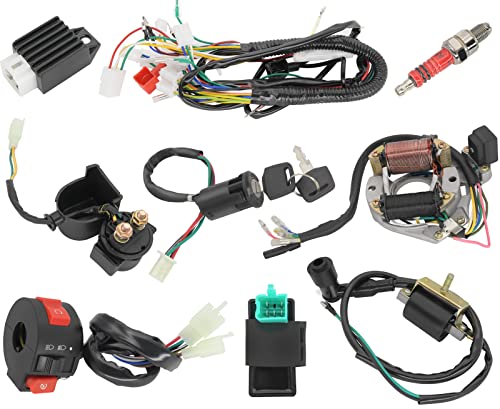
High quality and complete electrics all wiring harness wire loom assembly for QUAD / ATV parts,Complete Electrics Stator Coil CDI Wiring Harness for 4 Stroke ATV KLX 50cc 70cc 110cc 125cc - atv wiring harness ;DO NOT FIT: GY6 motorbikes and other 200cc - 250cc Zongshen Lifan ATV / QUAD with different stator or CDI.

High Quality: This female adapter wiring harness sockets is made of high-quality materials, the nylon shell has good insulation, heat-resistant and flame-retardant, has good toughness, is not easy to deform or crack, the internal copper wire can stably conduct electricity, has high working efficiency, and can be used for a long time
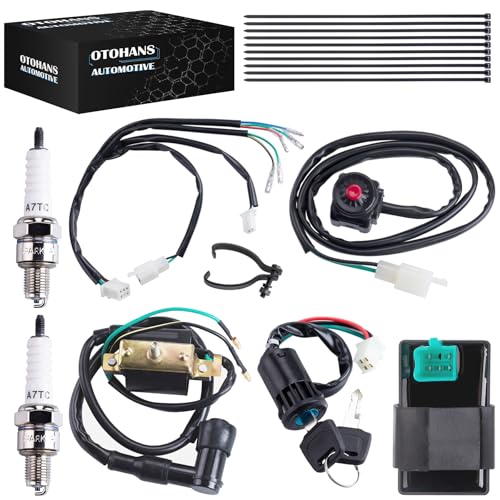
Comprehensive Compatibility: Designed for 50cc to 160cc 4-stroke dirt bikes (kick start only), this kit works seamlessly with engines from brands like Lifan, Loncin, Tao Tao, Ducar, Shineray, Zongshen, and YX, ensuring broad applicability for Chinese bikes.
Pre-2008 Generation: Doohickey Failures and Reliability
If you own a pre-2008 KLR 650, the so-called “doohickey” represents your most critical maintenance concern—a poorly designed balancer chain tensioner mechanism that fails predictably between 5,000-15,000 miles. This aluminum component wears prematurely under dirt and moisture exposure, and when it fails, you’ll experience catastrophic engine damage from broken timing chains. The worn tensioner creates excessive slack, allowing chain slap that can destroy engine cases. You’ll need doohickey upgrades using steel aftermarket replacements to prevent failure. Beyond this mechanical time bomb, you’ll face excessive oil consumption—up to one quart every 500-750 miles under highway loads—caused by inadequate piston ring design. Combined with wiring harness abrasion issues and frame stress at mounting points, pre-2008 models demand aggressive preventive maintenance to maintain suspension performance and overall reliability. Early models also suffered from a weakly welded shift lever that typically failed at the weld point, often leaving riders stranded and requiring proactive replacement with aftermarket alternatives.

🔧 【Complete Doohickey Upgrade Kit for KLR650】Designed for Kawasaki KLR650 balancer chain tensioner service, this complete kit replaces the factory tensioner lever and spring with an upgraded torsion-spring setup. Includes the doohickey lever, torsion spring, rotor holder, rotor puller, gaskets, hardware and installation components needed for the upgrade.
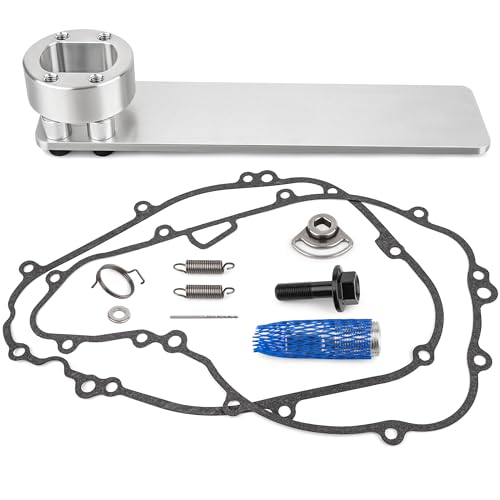
· Upgrade the counter balance mechanism system with a stronger doohickey than a weak stock

Fitment:For 49cc, 66cc, and 80cc 2 Stroke Engine Motorized Bike
Kickstand Deployment Issues in 2008 Models
The 2008 KLR 650’s kickstand safety switch fails with alarming regularity, killing your ignition mid-ride or preventing startup when you shift into gear. Off-road conditions accelerate this failure—dirt, sand, and mud infiltrate the switch internals, causing erratic operation and intermittent false signals. You’ll experience sudden stalling or complete no-start conditions as the electrical system incorrectly reads kickstand position.
Diagnosis is straightforward: if your bike runs rough only when shifted into gear or dies unpredictably during operation, suspect the kickstand switch first. Many riders implement safety modifications by bypassing the switch entirely, looping the harness connector to permanently signal “kickstand up.” Aftermarket bypass kits offer plug-and-play solutions with soldered connections for durability. While this eliminates the fail point, you sacrifice the safety interlock—meaning your bike will start and run with the kickstand deployed. Testing the switch with a digital multimeter reveals whether continuity breaks properly when the kickstand moves between up and down positions.
Gen2 (2008-2019) Build Quality Concerns
While Kawasaki marketed the Gen2 KLR 650 as a refined evolution, cost-cutting measures throughout the 2008-2019 production run resulted in inconsistent assembly quality that you’ll notice immediately upon inspection. Your build quality assessment should focus on electrical connections—faulty switches and substandard wiring frequently cause intermittent failures. You’ll find the fuel system components particularly problematic, with fuel pumps and filters requiring premature replacement that compromises performance reliability. Chain and sprocket assemblies often show accelerated wear from inadequate factory tensioning. The 652cc engine’s oil consumption issues stem from questionable manufacturing tolerances rather than design flaws. Over-tightened head bearings affected approximately 2,000 motorcycles, creating steering difficulty that compromises control. Despite the improved suspension geometry, fastener torque specifications weren’t consistently applied, leading to loose bodywork and mounting hardware. These assembly shortcuts directly impact long-term durability.
Cold-Start Problems in Early Gen3 Models
Despite Kawasaki’s extensive redesign for the 2022 Gen3 KLR 650, you’ll encounter severe cold-start failures when ambient temperatures drop below 25°F—a critical flaw that undermines the bike’s adventure-ready reputation. The root cause traces to an overly aggressive exhaust cam decompression mechanism that drops cranking compression to 97 psi, making ignition nearly impossible regardless of battery condition or throttle input.
Dealers implement cold start remedies by disassembling the top end and modifying the decompression pin on the exhaust cam—a warranty-covered fix that’s handled case-by-case rather than through formal recall. Successful repairs boost cranking compression to the mid-90s pounds range, with running compression estimated near 180-190 pounds. Production variance means not all Gen3 units suffer from seasonal effects, but multiple documented cases confirm the pattern. If you’re considering a used 2022-2023 model, test cold-start performance below freezing before purchasing.
Model Years to Avoid Without Documented Repairs
Beyond intermittent cold-start failures, certain KLR 650 model years present systemic defects that warrant complete avoidance unless verifiable repairs exist in maintenance records. The 2008-2009 production run suffers from notorious excessive oil consumption caused by inadequate manufacturing tolerances between pistons and cylinders. This allows oil to leak past piston rings, requiring frequent top-offs and risking catastrophic engine damage without diligent monitoring. Specifically, 2008 oil leaks stem from these tolerance failures, while 2009 engine maintenance demands are equally burdensome. Unless you can verify documented repairs addressing these oil consumption issues—such as upgraded piston rings or re-bored cylinders—avoid these model years entirely. Early second-generation bikes (2010-2012) show improvement but may still exhibit minor oil consumption. Pre-2008 first-generation models and post-2009 second-generation bikes with the 685cc upgrade represent safer used purchases. Buyers should also exercise caution with 2022 models, which have exhibited minor electrical glitches that suggest checking for available recalls or manufacturer fixes before committing to a purchase.

OEM Oil Change Kit For KLR650.

Fits: (1987-2024 KLR650 ALL YEARS AND MODELS)

Fits: 1987-2024 KLR 650
Verifying Recall Completion Before Purchase
Before signing any purchase agreement, run the KLR 650’s 17-character VIN through both Kawasaki’s official recall database and the NHTSA’s free lookup tool to identify outstanding safety campaigns. This dual-source recall verification validates whether repairs like the 2023 fuel pump replacement have been completed. The 10th VIN digit reveals the model year, helping you filter applicable recalls from irrelevant notices affecting other variants.
Contact Kawasaki customer service at 866-802-9381 if online systems show incomplete data or conflicting results. Dealers may know about recalls before official notifications reach owners, so request documentation proving repair completion. NHTSA’s database covers approximately 30 years of vehicles and confirms repair status regardless of ownership changes. Federal law prohibits selling recalled products, so verifying completion protects both buyer and seller from legal liability.
Cross-reference the frame VIN against the title to verify authenticity. This purchase safety protocol prevents inheriting deferred recall work and potential mechanical failures.


Fitment Compatibility: Motorcycle windscreen risers compatible with KLR650 2022-2025, ensuring a proper fit and optimal functionality for your motorcycle

[Adaptation]: PACEWALKER Adjuster Windshield Risers fit for KLR650 2022-2024